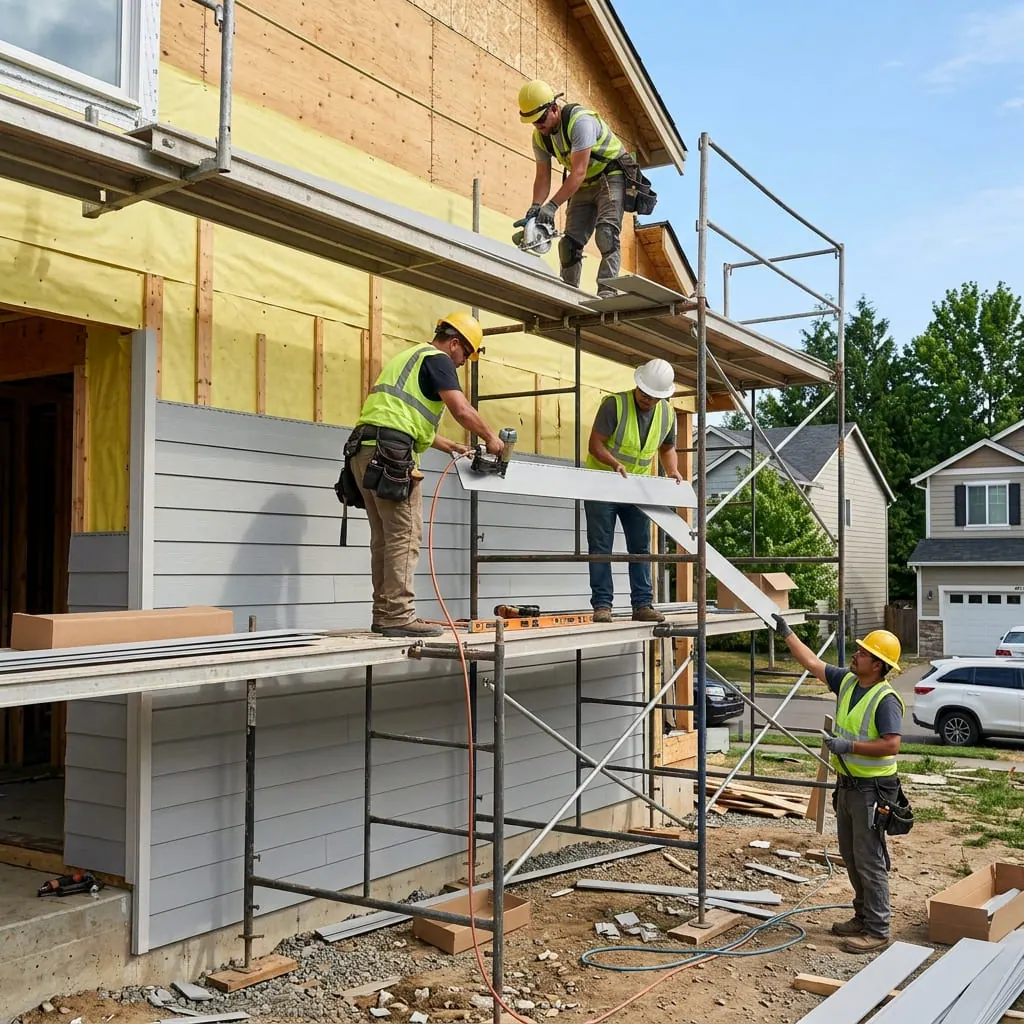
Siding Installation for Mason, OH Homes With Masonry Fronts
Mason is one of the most consistently well-kept suburbs in the Cincinnati area, and the housing reflects it. Much of it was built from the 1990s through the 2010s in planned communities where curb appeal is part of the neighborhood standard. Many of those homes have a brick or stone front, siding on the other three sides, and a lot of trim detail that has to stay tight to keep water out.
That makes siding decisions in Mason a little more particular. Homeowners here often weigh premium products such as James Hardie fiber cement against quality vinyl, and they care about clean lines, tight trim work, and colors that will still look right in fifteen years. The problems on Mason homes are usually details, not whole-wall failure. Call (513) 468-5818 to reach a siding contractor in Mason.
Mason exteriors are more mixed than in most suburbs, which changes how siding projects are planned:
A proper siding job on a Mason home starts with an exterior inspection, so the scope matches what the walls actually need.
Planned communities with design standards. Approval for color, material, and trim is common. Working within those rules from the start keeps projects moving.
Brick or stone fronts with siding on the sides and rear. Every place where siding meets masonry is a flashing detail. New siding has to tie into the existing wall cleanly and shed water outward.
Vinyl from the 1990s and 2000s reaching replacement age. The oldest neighborhoods are now at the point where original vinyl is faded and homeowners upgrade materials rather than repeat what was there.
Early fiber cement and painted trim. Some higher-end 2000s homes have fiber cement with field-painted finishes. Paint and caulk at butt joints wear out on a schedule, usually well before the boards do.
Accent details. Board-and-batten gables, shake accents, and stone veneer bases add character and are worth planning together with the main siding.
What Fails First on Mason Homes, and Why
Newer construction fails differently than older homes. On Mason houses, trouble usually starts at the details rather than in the middle of the wall:
Flashing where siding meets brick or stone. This is the most common hidden leak point on Mason homes. If the transition was caulked instead of flashed, or the flashing was cut short, water tracks behind the siding and rots the sheathing at the bottom of the wall. Stains and soft spots near the base of side walls are the tell.
Caulk and paint at trim and butt joints. On fiber cement and painted trim, sealant at butt joints and around windows lasts roughly 10 to 15 years in sun. Once it opens, water gets to the cut edges of the boards first, causing peeling paint and swelling long before the panel face looks bad.
Fading on sun-facing elevations. Vinyl from the 1990s and 2000s fades unevenly, with south and west walls going chalky while shaded walls still look fine. The mismatch becomes obvious next to the brick and shows up in listing photos, so many owners replace before selling.
Gable, dormer, and roof-to-wall intersections. Complex rooflines create step flashing and kick-out points that were installed quickly on a large production schedule. When they fail, water runs down the wall behind the siding, not on the roof where you would notice it.
A premium, low-warp material with crisp shadow lines, well suited to homes where appearance matters most. Factory-finished boards hold color and avoid the repainting cycle that field-painted siding needs. Works especially well next to brick and stone.
A cost-conscious upgrade with added rigidity and a bit of thermal benefit, available in HOA-friendly colors. A good choice for side and rear walls when the front elevation is masonry.
Stone veneer at the base or on columns adds depth and pairs well with lap siding. It has to be planned with the siding so flashing and trim transitions are sealed properly from the start.
What to Look for in a Siding Contractor in Mason
A complete siding job in Mason comes down to who you hire and what the scope covers. Verify these before work starts.
Current insurance and references. Ask for general liability and workers’ compensation certificates and recent Mason-area addresses where the same product was installed.
HOA and design-guideline experience. Many Mason communities review material, color, and trim. A contractor should provide a sample and submit for approval before ordering.
A flashing plan at masonry transitions. On brick- and stone-front homes, confirm the crew flashes and builds a drainage path where siding meets masonry, not just caulk.
Factory-finish and trim detail. For fiber cement, confirm cut edges get sealed and butt joints are detailed so the finish lasts without the field-paint cycle.
One coordinated scope. If stone accents or board-and-batten gables are part of the look, the scope should cover them together so every transition is sealed once.
For many homeowners, yes. It costs more up front but resists moisture, fire, and warping, and a factory finish avoids frequent repainting. It also looks better next to brick and stone than aging vinyl does. It is a strong choice if you plan to stay long-term or expect to sell where curb appeal drives the price.
Can siding be combined with stone or brick?
Yes, and on Mason homes it is the norm. The key is proper flashing and a drainage path where the two materials meet, so water cannot get behind either one. Sealant alone is not enough. This is the first place to look if you see staining or soft spots along the bottom of side walls.
Do I need HOA approval to replace siding in Mason?
Many Mason communities have architectural guidelines covering material, color, and trim. Check your covenants before choosing, and submit the request early with a sample. Approval often goes faster when the new siding matches the neighborhood palette and keeps the same profile as what is on the house now.
How long does a full siding replacement take?
Most Mason projects take about one to two weeks depending on home size, the number of stories, and weather. Repairs to sheathing found behind old siding, especially at masonry transitions, can add time. Permit lead time is separate, so confirm requirements with the local building department before you set a start date.
Should I replace soffit and fascia at the same time?
It is usually smart to. Scaffolding and access are already in place, and matching new trim to new siding gives a cleaner result than mixing new and aged materials. On detailed Mason rooflines with many gables, doing it once also avoids paying for a second setup later.
Work is performed by independent professionals.
Call Now for Siding in Mason
Siding work on a Mason home starts with an exterior inspection that sets the scope. Call (513) 468-5818 to reach a siding contractor in Mason and surrounding Greater Cincinnati.