Heavy-gauge vinyl
The practical upgrade from builder-grade panels. A thicker profile resists the cracking and waviness that show up on 1990s vinyl, and lighter colors stay cooler on open, sunny lots. Best value for most two-story homes.

West Chester Township grew fast, and much of it grew at once. Whole subdivisions went up in the 1990s and 2000s, which means thousands of homes are now hitting the same milestone together: original builder-grade vinyl that is 20 to 30 years old, faded, brittle at the edges, and starting to let go at seams, corners, and the tops of tall gables.
These are mostly large, open-lot, two-story homes with full afternoon sun on the south and west walls and long unbroken runs of siding that catch wind. That exposure is hard on thin, aging panels. If your West Chester home is showing cracked panels, chalky color, or wavy sections near the windows, it may be time to compare repair against a full siding replacement. Call (513) 468-5818 to reach a siding contractor in West Chester.
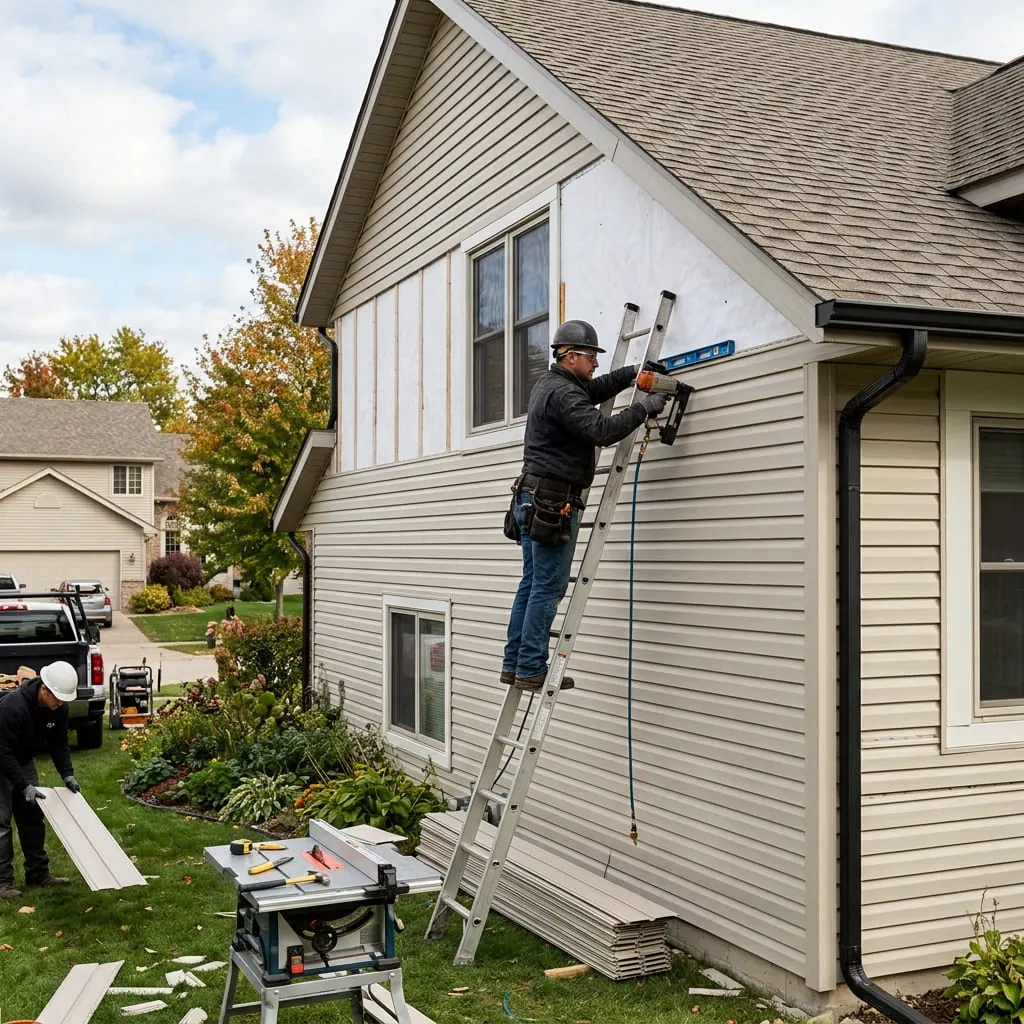
Most of the housing here was built in one long wave, so the same materials and the same shortcuts show up street after street:
A proper siding job on a West Chester home starts with an exterior inspection, so the scope matches what the walls actually need.
On homes in the 20-to-30-year range, the same handful of failures appear in roughly the same order:
Fading and brittleness on south and west walls. Thin vinyl loses the UV stabilizers in its color layer and the plasticizers that keep it flexible. By year 20 to 25 it goes chalky, and the first cold snap or ladder bump cracks it, usually at the nail slots.
Warping beside windows and doors. Modern low-E glass reflects heat onto the siding next to it. On dark or thin vinyl this causes waves and distortion near windows, a problem that gets worse each summer and cannot be repaired without replacing the panels.
Wind unzipping at gables and eaves. As vinyl ages, the locking lip at the bottom of each panel loosens. On tall two-story walls, wind gets under the top courses and peels them, often in a line across the whole wall rather than one panel at a time.
Failed caulk and flashing at masonry transitions. Where vinyl meets brick or stone, and at garage door headers and window tops, thin sealant lines dry out and pull away. Water then runs behind the panels into the sheathing, where you cannot see it until stains or soft spots appear.
For most West Chester homes, the decision comes down to these options:
The practical upgrade from builder-grade panels. A thicker profile resists the cracking and waviness that show up on 1990s vinyl, and lighter colors stay cooler on open, sunny lots. Best value for most two-story homes.
A long-lasting choice for homeowners planning to stay. It does not warp near low-E windows, holds color, and stands up to wind better than aging vinyl. Many owners use it on the front elevation and vinyl on the sides and rear to manage cost.
Original aluminum or vinyl soffit and painted fascia on 1990s homes are aging in step with the siding. With scaffolding already up on a two-story home, replacing them together is the cheapest time to do it.
A complete siding job in West Chester comes down to who you hire and what the scope covers. Verify these before work starts.
Serving homeowners throughout West Chester Township and neighboring Liberty Township and Fairfield Township. Also serving the rest of Greater Cincinnati. Nearby: Mason, Liberty Township, Anderson Township.
On a 1990s or early 2000s home, look for chalky, faded color on the south and west walls, cracks at the nail slots, waves next to windows, and panels that rattle or lift in wind. If you see several of these on more than one wall, replacement is usually more economical than repeated repairs, especially since new panels will not match old faded ones.
Many West Chester subdivisions have an HOA or architectural committee. Check your covenants for approved materials and colors, and submit the request early because reviews can take a few weeks. Bring a product sample and color name with the request, since committees usually decide faster when they can see exactly what is proposed.
Low-E window glass reflects sunlight and heat onto the wall beside it. On thinner, older, or darker vinyl that reflected heat can exceed what the panel tolerates and cause waves. It tends to return every summer. The permanent fix is heavier-gauge vinyl in a lighter color or fiber cement, which does not distort from heat.
Heavy-gauge vinyl and fiber cement both handle sun exposure much better than the builder-grade vinyl common on 1990s homes. Lighter colors fade less and run cooler. On tall gables where wind is the bigger threat, correct nailing and secure corner and trim details matter as much as the material itself.
Often yes, but matching 20-year-old faded vinyl is difficult because the original color is usually discontinued and has weathered. Replacing one wall works best when it is a back or side elevation that is not seen next to the old siding. On a wall people see, replacing the whole exterior gives a cleaner result.
Work is performed by independent professionals.
Siding work on a West Chester home starts with an exterior inspection that sets the scope. Call (513) 468-5818 to reach a siding contractor in West Chester and surrounding Greater Cincinnati.